


The NOGUCHI exhibition ran from 30th September 2021— 23rd Jan 2022 at the Barbican Art Gallery, London and it was the first life work retrospective in the UK spanning Noguchi’s prolific and expansive career. The above image shows how this incredible show was such a good fit in the space of the Barbican Art Gallery. Similar sensibilities and thought patterns are evident within the work of both Noguchi, the influential Japanese-American sculptor/designer/architect and Chamberlain, Powell and Bonn the architects of the Barbican Art Gallery and Estate. Through the sharing of similar attitudes concerning physicality, form, materiality and space and the idea that space is as important as physical structures themselves, many crossovers are visible which added to the success of this exhibition.
Some of the highly textured, chiselled and drilled surfaces of Noguchi’s stone sculptures almost blended completely into the beautiful bush hammered concrete walls of the gallery. One observation as someone who has spent hours in the Barbican Art Gallery is that the tactile surfaces of the gallery’s walls draw almost as much attention as the artworks themselves, people can’t resist to touch and run their fingertips along the tactile concrete surface.

The beautiful installation of bronze sculptures titled ‘Lessons of Musokoshi’ were each shaped by foot (Noguchi’s feet) pressed into huge lumps of clay before casting in bronze. In their granite like stances, full of movement yet frozen in time, they look like huge super-imposed chunks of the Welsh Pen Li seen exposed in the concrete walls of the Barbican, which also parallel movement trapped in space and time. The Zen garden master Muso Kokushi and a secret rock garden played a part in inspiring this 5-piece installation which sat beautifully in the Barbican Art Gallery.

I’ve been waiting for an exhibition on the work of Noguchi for a long time; Noguchi is one of my all time favourite creative thinkers and makers. I have the impression he is relatively unknown too many British people apart from the odd few people who may have visited the Noguchi Museum in New York. If shown one of his creations such as his ‘Akari’ Light however, (which became the inspiration and template for most paper lamps to follow…) a high proportion of the British population would be very familiar with this famous design and product. There was a beautiful installation of the lamps in the Barbican Conservatory opposite the Art Gallery for the duration of the Barbican exhibition. I’m sure this incredible exhibition of Noguchi’s work will have certainly brought wider attention to and recognition of his work to the many visitors fortunate to visit this exhibition, many of which encountering his work for the first time.
I discovered the work of Isamu Noguchi, in 2005, through learning about the work of Kitaoji Rosanjin – chef turned potter (see Rosanjin Spring post). Noguchi, a good friend of Rosanjin’s, produced his first ceramic work in Rosanjin’s studio.
In 2007, while living in Japan, I planned a road trip to the Island of Shikoku to visit the Iya Valley, some of the 88 temples on the Shikoku Henro pilgrimage route and the Shikoku Tabe yaki ceramic kiln site.
While planning the trip I discovered by chance the existence of Noguchi’s Japanese studio and garden and that it was a short distance from where I was heading. I had to include it in my trip and I’m very happy about that decision! I was especially in awe of his work in stone which is the material that makes up a large portion of the work in Mure and it was here where my real admiration of Noguchi began. Here’s the studio and the garden from the outside, photo’s were not allowed inside.

The great thing about the exhibition in London was that it brought Noguchi’s work together from the 1920’s to the 1980’s from different international collections, into one space, enabling the visitors to see the evolution and journey of his work and thinking.
Blog post still in progress…


Hotel Hannon, 1903 (fish eye)
Jules Brunfaut built this magnificent manor house for his childhood friend Édouard Hannon who lived there from 1904-1965 . The building is now open to the public and shows experimental photography exhibitions. The interior looks incredible from images I have seen online – unfortunately i didn’t get to go inside this time.
The interior parades vibrant mosaics, frescoes and stained glass windows. A mahogany spiral staircase with a wrought iron balustrade connects the floors in true Art Nouveau style.
Adjoined to Hotel Hannon on Avenue Brugmann is Maison Les Hiboux, completed in 1899, by architect Édouard Pelseneer.
The name of the building ‘Les Hiboux’ (Owls) sits between two stylised owls and floral motifs on stone above the entrance door. This type of scraffitto design and the organic shapes within the ironwork and window frames are typical of Art Nouveau.
The combination of different materials, colours and textures combined in an asymmetrical layout create a very interesting building. The rich red brick colours and white and blue stone work compliment the warm yellow and orange sgraffito paintings and the deep browns and greys of the wood and iron.

I’ve not looked at any Art Nouveau since my school days – despite it being the Art Nouveau works by creative geniuses such as Gustav Klimt and Victor Horta that got me hooked on art in the first place. During a recent trip to Brussels, I became completely immersed once again in an incredible mix of art nouveau-style architecture displaying a wide range of possibilities with shaping and combining materials – particularly iron and stone. In this post I’ll share images and a little information of some of the buildings I discovered while exploring Brussels.
‘Art Nouveau-Baroque’ Maison Saint-Cyr with its tall narrow facade (4m wide!) and extravagant ironwork can be found at 11, Square Ambiorix.

Details of lacey floral-motifs in iron
Gustave Strauven, designed this famous house for the painter Georges de Saint-Cyr and it was one of Gustave Strauven’s most important buildings. He cleverly juxtaposed various materials (brick, iron, stone, wood, glass) linking them with a crazy organic style full of movement. It is quite clear that the architect liked to utilise new technologies and experiment with different materials.
Some of my favourite details: the linking/bolting together of the iron work (see slide show images above), and the metal and stone balconies with hidden stone engraving on the underside of the balconies which almost look like a shadow of the metalwork (seen when looking up from underneath – see right hand picture below). Unfortunately this incredible building has been falling into disrepair for years as not all old buildings with historical significance are protected in Belgium. Thankfully some repair works started to be made on it in 2013.
Maison Cauchie – Cauchie House – built by Paul Cauchie in 1905 is located in front of the Parc du Cinquantenaire.

‘Scraffiti’/’Sgraffito’ facade – colour drawing into cement. Applying colour, line and texture in the same way that sgraffito is used on clay. The exquisite allegorical drawings on this building are one of the elements which has led it to being viewed as one of the most important masterpieces of Art Nouveau in Brussels. Paul Cauchie specialised in designing sgraffiti for architecture, and was decorator more than architect. He created this home for his wife and himself as a huge advertisement to sell his work and services as a decorator and architect and his wife skills as a teacher. Cauchie and his wife furnished the house with fine art objects, paintings and furniture. The lettering above the door reflects the whole of the building, ‘Par Nous Pour Nous’ ‘By Us – For Us’.
Some of the metalwork here (above and below) demonstrates a more art-deco style.


I’m not sure of the name of the building above. It is not as flamboyant as some of the others but is nonetheless equally stunning and powerful.
Below is Maison Ciamberlani built in 1897 by Paul Hankar for the painter Ciamberlani. It displays a great combination of geometry and organic Art Nouveau form. Again Scrafitti envelopes most of the building’s facade. Paul Hankar the son of a stonemason, was a furniture designer as well as architect and innovator of Art Nouveau style.


Maison Ciamberlani is located on the same street Rue Defaqz as Maison Hankar (Paul Hankar’s own house) which was his first major architectural project completed in 1893. There are a cluster of great Art Nouveau buildings in this area of St Gilles and I was fortunate to be staying close by to them.
I love the geometric metalwork on the balconies, it reminds me of some old Japanese designs and furniture – particularly wooden lattice work that frames paper screens (room dividers) and shoji (traditional windows). Maison Hankar along with Hotel Tassel by Victor Horta are considered the very first two houses built in Art Nouveau style. Victor Horta and Paul Hanker also studied together and clearly shared similar interests and influences. Hotel Tassel is located in St Gilles a couple of streets from Maison Hankar.
Hotel Tassel – Victor Horta, 1893-94
Beautiful iron and stone work.

This building was built for the Belgian scientist Edmond Tassel. Victor Horta was breaking new ground in at the time through his use of iron and exposed rivets, alongside stone and glass, in domestic architecture. Some of the pillars of the building are even made from iron rather than stone. In the early 1900’s metal used in architecture was considered extremely modern.
 Victor Horta’s most well known building is probably, Horta House (his former home and studio) built between 1898-1901. It is now the Horta Museum.
The interior of the museum is astonishing. Unfortunately it’s not possible to take photos inside. The way light is harnessed in the building, particularly through a skylight above the most incredible staircase and railings make it a unique and exceptional space to experience.
Abstract curves, geometry and motifs entwine the museums’s architecture, interior design, and furniture (which all exhibit fine craftsmanship).
The exquisite cabinetry also includes finer details such as fixtures and fittings, for example door handles. A cabinet in one of the rooms displays a set of models of various handle designs and moulds of the handles in plaster. Most of these handles were cast in metal.


I’ve got a few more Art Nouveau architecture in Brussels images to share in my next blog post…
 L’ Eglise Saint-Jean-Baptiste au Béguinage is an incredible Flemish-Baroque building (completed in 1676) that I discovered in Brussels this month. It is situated just north of the Grande Place, close to Place Sainte-Catherine. The above image of the front facing external facade appears to soar into the sky, drawing any bystander in through its dramatic central projection.
If the dynamic exterior isn’t enough to play with your senses and spatial perception, the interior – an explosion of intricate detail and complex geometry, may create a stronger impression!


The architect of this masterpiece Luc Fayd’Herbe, was a student of Rubens. His inspiration from Rubens is apparent in his architecture, particularly in his powerful use of strong light-and-shade contrasts (creating chiaroscuro effects). The creation of various sized and shaped windows located at different heights, control the way light enters the space and aids illusory effects. Also, the Baroque feeling of objects entering one’s space and paintings spilling out of a two-dimensional space or canvas to touch the viewer, is certainly present. It is captured through a plethora of fluid interconnected curving and linear structures that can play with one’s perception, sense of space and imagination.


I was not aware of the great influence that the painter Paul Rubens had on architecture. Through his book ‘Palazzi di Genova‘ which, depicts and describes palaces of Genoa he introduced contemporary Italian architecture models to his students in the Netherlands. Rubens even had his own house (Rubenshuis, Antwerp) built in the Genoese style of architecture. I’m guessing Ruben’s played an important role as an artist and educator in initiating Luc Fayd’Herbe’s interest and understanding of Baroque-style, and in enabling him to evolve creatively and to cultivate ideas to develop a new kind of Baroque.
I have some more images which I’ll post at some point..

I thought it would be appropriate to share some graves, fine English Gothic Architecture and incredible stone, as this month’s blog has landed on Halloween. I have visited Whitby in North Yorkshire many times and many of my childhood holidays were spent there. I could never put into words the intriguing sense of awe, eeriness and mystery that I experienced whenever I passed by the abbey ruins and through St Mary’s churchyard. The church and abbey is built on a site with a long history – a Benedictine monastery was founded here in the mid-7th century. I made a journey along the top of the East Cliff, through the graveyard and past the abbey daily from the campsite where I stayed, to the fishing and seaside town at the mouth of the River Esk below.
Below are some pictures of the graveyard, followed by the Abbey with a few notes. I hope the images and annotations can begin to illustrate the aura of mystery and intrigue this place emits alongside a more uncanny atmosphere, which is difficult to put into words.

The cemetery overlooks the North Sea on the East Cliff above Whitby. The environment here can be harsh; the stormy weather and strong North Sea winds loaded with salt, have eaten into the tombstones over the years and created interesting erosion effects in colour and texture. Due to recent landslips from torrential rain and damaged drainage, the pathways along the East Cliff have now been closed.
The graves date from the 1600’s. Many of the grave stones have names of ships, trades or professions, a name and the place where the person died or is buried. There are 924 names recorded on the monuments and tombstones that mainly belong to local sailors, fishermen, royal navy seamen and lifeboatmen. The 199 stairs that lead from the narrow cobbled streets of the town, up the steep hill to St Mary’s and the Abbey, also form part of the churchyard. Below are some closer details of the weathered stone.


St Mary’s Parish is a Norman church that dates from around 1110. It has been added to and altered over the centuries, but still stands like a fortress ready to take on what the North Sea has to throw at it. It is not surprising that this graveyard was the setting chosen by Bram Stoker for a major scene his book ‘Dracula’.

“For a moment or two I could see nothing, as the shadow of a cloud obscured St. Mary’s Church. Then as the cloud passed I could see the ruins of the Abbey coming into view; and as the edge of a narrow band of light as sharp as a sword-cut moved along, the church and churchyard became gradually visible… It seemed to me as though something dark stood behind the seat where the white figure shone, and bent over it. What it was, whether man or beast, I could not tell.”
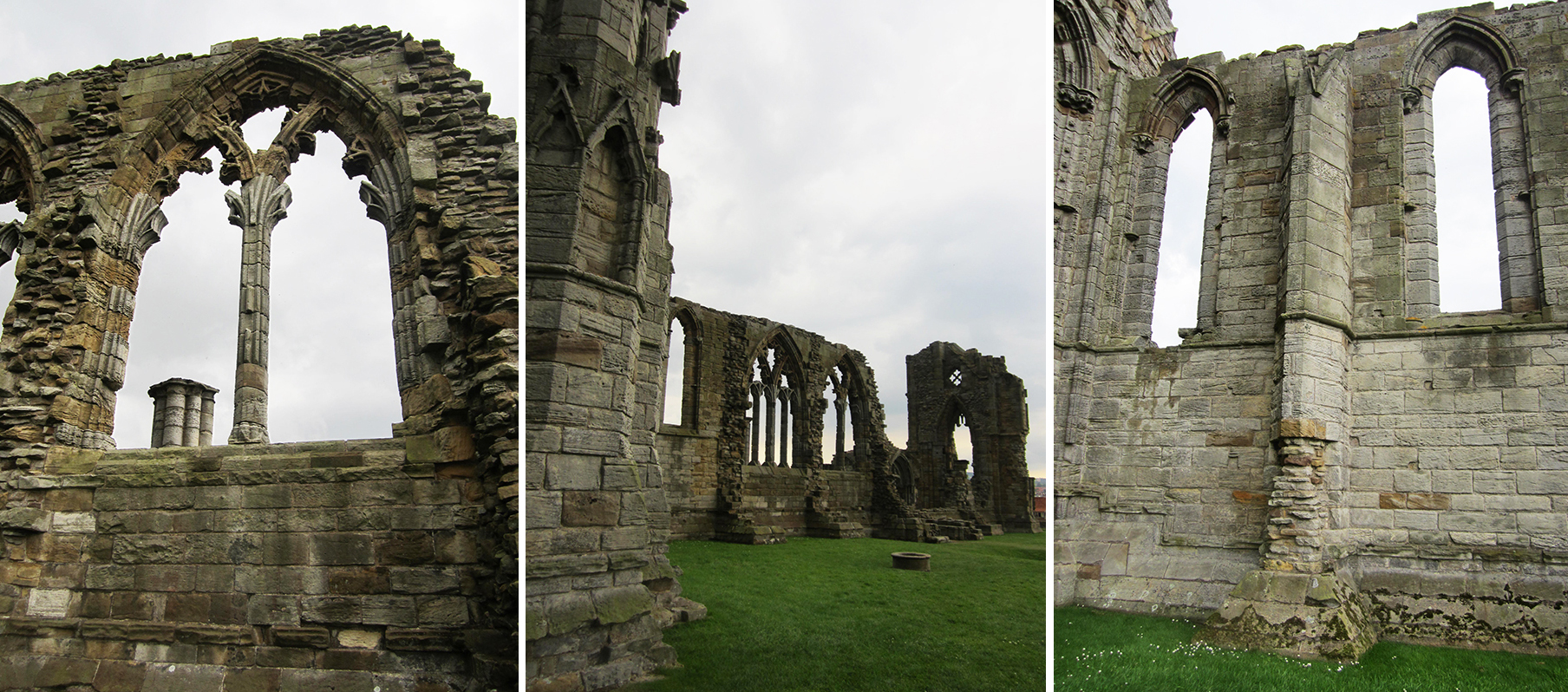
Whitby Abbey is classified as a major monument of Early English Gothic architecture and some parts still stand at full height.


There are some gorgeous colours and textures to be found in the stone walls between the church and abbey, below are a just few examples. The erosion and direct environmental effects over hundred’s of years have created a range incredible tactile surfaces. Also notice the fossil embedded in one of stones.
A mixture of bold golden ochres and rich terracotta colours harmonise with pure whites, slate greys and deep chocolatey browns to make up the Abbey and its walls. Some of the colours and textures collide in a variety of ways creating vivid effects. Colours that have mixed and merged naturally in the materials of the stone appear as marbled effects, overlapping patches, waves and splashes of colour, speckles and streaky linear markings. 

The view above is out onto the headland surrounding the abbey, towards the East Cliffs and North Sea. The ruins of the medieval abbey church stand in magnificent isolation within this large open expanse of land. Originally, however, the church would have been at the centre of a large group of monastic buildings.
Above are a few overview images of the abbey and below a view from the Abbey looking out to a huge storm brewing over the sea. The shell of the abbey church remained mostly complete until the 18th century; it was then weakened by erosion from wind and rain. This resulted in the collapse of the south transept in 1736, followed by the nave in 1763 and the central tower in 1830.


The stone seems to fascinate me the most, possibly because of the layers of history trapped within it, alongside its natural tactility, sheer mass and strength. A long history of this area including Viking raids and shelling from the German High Seas Fleet in 1914, is marked in its stone, etched, imprinted and engraved in its surface. This gives the stone its own stories over space and time and unique build up of character. Fossils embedded in the stone can tell us about once living creatures in the area, the textural markings can tell us about the changing atmospheric conditions and the sea, and colours can tell us about the types of clay and minerals available naturally in the surrounding earth. The remains of the abbey church that can be seen today date from the 13th century onwards.


The abbey is a good example of fine Romanesque masonry and the remaining North and East transepts (built in the 13th Century) were most likely inspired by the transepts at York Minster Cathedral. They represent the time when English Gothic came into its own and shifted from heavy French gothic influence – so it was created at an important time and an example of one of the first truly English Gothic monuments.
Colossal comes to mind when viewing the above photos… The distinctive ‘clustered’ columns of the abbey and its richly moulded arches are a typical example of the Early English Gothic style. Also again, these images highlight all the wonderful colours and textures and I’m sure I can see some monstrous faces etched into the stones and protruding outwards.


Between 1920-1930 major excavations at this site revealed evidence of the Anglian settlement that once existed here where the abbey stands. Also between Between 1993 and 2008 English Heritage carried out excavation and survey work to rescue archaeological remains, threatened by steady erosion of the East cliff. The excavated artefacts formed important evidence for all periods of the abbey’s history and evidence of this spot in Whitby being one of the most important religious centres of the Anglo-Saxon world.
A few final pictures…

A concrete lectern I have been working on for St Edmunds church in Chingford. I took a few photos early this morning outside the studio before taking it to the church.


A bronze strip is set into the top surface which the church’s Book of Remembrance will rest against. I patinated the bronze to discolour it slightly giving it a worn look. The bronze has a lot of copper in it which is warm against the cool concrete surface.


I will add a few more pictures later of the whole lectern from different angles and closer pictures of the pedestal surface which has an engraved effect and contrasting surfaces.
Installing in the church this morning.
ok, I think this is the most behind I’ve been with my blog.. been busy in the studio – hope to catch up soon with the previous blog and this months
Every residency programme is unique and the words and images above are from a few makers who joined the SCCP residency progamme between 2005-09. I introduced SCCP in an earlier blog (Shigaraki Ceramics Cultural Park – A site for creativity) which gives an insight into the ceramic paradise I landed myself in, during the summer of 2005. I fell in love with the great clay and kilns, the people and the culture, so packed up and moved to Japan in 2006 and Shigaraki became my kiln firing home until the end of 2009.
Everyone, including artists in residence, staff at SCCP and people living in this ancient ceramic town were connected by their love and appreciation of ceramics. People showed kindness and respect to others sharing the wonderful studio spaces there that overflowed with creative energy.
To start, here’s a very brief glimpse into my own experience, followed by notes about some of the wonderful creatives I shared my 2005 residency with at SCCP, including the inspiration they took from their experience at SCCP, Shigaraki, Japan.

Working with local clays I developed new appreciations for the qualities of raw unglazed ceramics. Shortly after arriving I was shown a clay sample book of hundreds of ceramic test tiles; it took me a while to decide which clays to work with, to adapt to new ways of working and in such a different working environment and climate. Everything I experienced in Shigaraki was so different and new to me, and I was so curious to learn about this new place and culture; it was like seeing with new eyes. I made my first pieces of work inspired by architectural form, space and light. The Miho Museum a contemporary architectural masterpiece built inside an ancient Shigaraki mountain (see blog post Miho – A sacred Architectural place in the mountain) was of great inspiration as it enabled me to start see, think and question in new ways.

Spending time with other artists chatting in the studio, over tea breaks, in the evenings while cooking or during a walk into town was enriching for all. Even learning to communicate with a Japanese friend and fellow artist through origami inspired new ways for me to work using geometry, folding and layering in my ceramic objects treating them like paper. Time outside the studio was important for me too, I even earned the name ‘Kyoto Jo’ after making a quite a few trips there during my residency period. The time spent experiencing this new culture was such a precious and influential part of my creative journey.
Japanese artist Ayano Ohmi who was based in New York (and originally from Tokyo) built a series of totem-like sculptures to stand permanently in the natural landscape. The contours of the mountains that surround Shigaraki inspired this series of work, which was produced using the rich textured black coloured clay from Shigaraki’s mountains.

Working from her charcoal drawings, Ayano planned how to construct her sculpture in sections. Learning from Ayano’s construction technique inspired projects that I led back in the UK enabling secondary school students to build personalised outdoor totem-like sculptures for their school, which are still standing today.
Ayano deeply missed Shigaraki clay when she was back in the States and agreed with me that there is something very special about Shigaraki clay. There’s no other clay like it! The clays from different regions of Japan are very different and certainly from country to country. Luckily Ayano is back in Japan now so has good access to Shigaraki mountain clay!

The above photo is a shot looking down on the Shigaraki Ceramics Park and the surrounding mountains in the evening, while listening to the cicadas and noodle van moving around town.
There’s nothing more elemental than working with earth straight from the mountain. Because of different clay qualities, uses and desired finishes from country to country, each artist brings to Shigaraki entirely different working processes that have been adopted in their own countries. This makes the studio a hotbed for knowledge transfer and creativity. Artists can generate new ideas and find solutions when engaging with one another.
Sungmi Ha from South Korea sums this up very well in her statement below about her experience at SCCP in 2008.

“The clay of Shigaraki is nostalgic for me too, I love Shigaraki clay. It was good to meet the potters of many countries in Shigaraki, and to be able to see directly the work of other people. It was nice for so many people to come in contact through simple pottery and the work throughout the ceramic park.
When I try to work alone, it’s common to experience difficulties. At Shigaraki I was able to share mutual understandings with a variety of people and to understand the advantages and disadvantages of my own work. So my work was able to grow and develop on new levels. I recommended the residency to many potters.” Sungmi Ha

Having the ability to work alongside international creative professionals with different kinds of experience is a valuable part of the Artist in Residence programme.


Language barriers made communication with members of staff and fellow artists challenging sometimes but even with these slight obstacles we were all dealing with similar issues and the language of our material and creativity brought us together in understanding. It wasn’t a problem if some of the artists or technicians were not completely fluent in English or Japanese and it was exciting to work through challenges with people all linked by a common thread. There was also the curiosity and thirst for knowledge when working with new types of clay, materials and processes that encouraged one to question one’s usual working methods. Recognising and respecting different perspectives, being open to the ideas and views of others are important skills that develop while participating in residency programmes.

“I think being an artist in residence is good because an artist can know new techniques from different artists and learn about another country’s culture and we can make friends all over the world. It’s difficult to explain, but I think there are a lot of possibilities in Artist in Residence.” Matsunami Yoshimi, Japan, SCCP Technician
At SCCP there is the opportunity to visit other ceramic artists working in Shigaraki and there are many! The image on the left shows Shigaraki potter Bungo San inside his studio throwing large bathtubs on a Japanese style potter’s wheel. Having the opportunity to meet potters in Shigaraki town was inspiring for us back in the studio. The image on the right is of Johaness Nagel from Germany who experimented with pushing the boundaries of scale for thrown vessels. This work may have been inspired by his visit to Bungo San’s studio and other artists working on larger scales.

Shigaraki Ceramics Park has a 5.2m³ trolley gas kiln so it is possible to experiment with large scale work. Specialist equipment available to support, lift and transport work also aid the making of larger objects. Another artist in residence who was also interested in pushing the boundaries of scale but with figurative sculpture was Nel Bannier from Netherlands. She became fascinated with the technique of Japanese lacquer and at the same time she experimented with Japanese lacquer on her smaller-scale ceramic models. Here are a few words she had to say about her Shigaraki experience:

“And Shigaraki? I still dream about it. If I could repeat it, I would. The support and joy of staff and fellow artists was so great and made me excel beyond my own imagination”. Nel Bannier, The Netherlands

Sylvie Godel from Switzerland and was an Artist in Residence at SCCP in 2005 and made a series of porcelain bowls and containers with holes pierced into them and fine strands of thread, threaded through. From her walks in the rice fields and cycling around Shigaraki town, she was able to absorb this new environment and interpret it through the ceramic objects she made back in the studio. She found connections with the colours, the touch of long grasses and the smells of the rice fields, and linked this with food and bowls to create beautiful tactile objects.
While at SCCP Sylvie visited Osaka aquarium where she was intrigued by a room full of jellyfish. The jellyfish’s graceful movements and transparency fascinated her and is also reflected in some of her beautiful bowls. I am proud to own one of them!


Lars Christin Rank from Denmark shared the same 3 month residency period as Sylvie which overlapped with me for 2 months. His inspiration from Japanese modular systems of stacking, food items like bentos, ceramic tableware, and the minimalist Japanese sensibility is definitely present! He previously experimented with many types of crystalline glazes – colourful crystal forming glazes. Being in Japan really enabled him to develop and apply a new aesthetic appreciation to his ceramic work. Here are a few words about his experience at Shigaraki:
“It’s great being on a residency, and I think first of all it’s because you have put everything else aside when you are there. You just have to focus on your art and project – with no everyday interruptions. And then you are in new surroundings – new culture and you are meeting new people. I think the best thing for me about being at Shigaraki was the introduction to Japanese culture and the Japanese way of seeing ceramics.” Lars Christin Rank, Denmark

Yokky from Hong Kong was fascinated by food so Japan was an inspirational place to be; the presentation of food in Japan is something else.. A trip to the local supermarket Heiwado amongst other food places or directly from the natural environment, Yokky would discover beautiful Japanese food inspiration, from lotus roots to all sorts of items I do not know the name of. Here she is working from large scale drawings making a ceramic wall installation. One of the joys of working in the studio in Shigaraki is to have the space around you to make and think it gives a different kind of freedom and luxury. Many artists who are fortunate to have a studio back home can often be working in small spaces. I know this is quite common in Hong Kong where space is limited.
I shared part of my residency period with Yokky in 2005 and was fortunate to meet up with her in Hong Kong and visit her studio in 2009. It was great to hook up with other ceramists in Hong Kong who I also met at SCCP and go out for dinner! One of the joys of being an artist in residence is making connections with people working in your field from countries all over the world – and visiting them 🙂

Hsiao San from Taiwan shared the same residency period as myself and for this reason I had a special bond with him. Both of us, like most people at SCCP, fully appreciated our time there. Hsiao San first worked on a large-scale sculpture inspired by a dream which was supported by a frame and bands of cloth. After a few weeks in Japan, Hsiao San became more and more fascinated with Japanese gardens, particularly rock gardens. The sense of movement and stillness found within them through the raked stones creating a sense of flow, direction and energy alongside the calmness of a carefully placed rock or mound of moss that acts as an island. He later began press moulding bowls and compressing flowing lines, oscillating textures and ripples into the clay surfaces. I think these pieces of work directly express what is experienced when sitting in a Japanese rock garden. They were definitely influenced by new understandings he gained from observations of traditional Japanese ways of connecting with and working with nature.

Hsiao San shared some wise words about being an Artist in Residence, “Set a pace and do not rush, take your time, it will take you a week to settle in”.
Hsiao San was another ceramist I was fortunate to visit in his home country of Taiwan, when I was visiting Taiwan to exhibit in the Taiwan Ceramics Biennale in 2008. He showed me around Taipei and even had me interviewed for TV at the National Palace Museum to talk about being an Artist in Residence in Shigaraki. We also took a road trip to Miaoli province to go and check out a Snake kiln (that will be a separate blog post)…
Blog still in progress…
Artist in Residence (AiR) programmes enable artists to take time and space away from their usual environment and commitments, to reflect, carry out new research and to explore their practice in depth and develop new skills.
Experiencing life in a new culture, working within a different community, making new friends and using the local materials all add to the experience. The conditions offered by AiR studios are conducive to creativity, skills development and idea exchange, through providing space and specialist facilities for the artists to use.
The Shigaraki Ceramics Cultural Park (SCCP) in Shiga, Japan has welcomed over 1000 ceramic artists and others from 49 countries to the Artist in Residence programme since it began in 1990. (See my post ‘Shigaraki Ceramics Cultural Park: A site for creativity’).
This year SCCP will host the International Ceramic Art Workshop and Symposium, ‘From the Perspective of the Artist in Residence’ to celebrate its 25th anniversary.
The purpose of the symposium is to discuss and learn about the state of international residency programmes. Visitors and guests will include residency hosting organisations and artists, designers and other creative professionals who have partaken in residency programmes.
The current global economic climate has hit the creative sector hard. Many residency programmes are struggling and it has become more difficult for artists to find ways of sustaining their own studio practice, let alone financing an AiR project. Funding cuts in the arts have also affected the numbers of artists applying to AiR programmes. Right now as artists and creative thinkers we need the kinds of places and resources offered by AiR programmes more than ever.
Can the global recession and changes in society present an opportunity to re-consider basic conventions and plan for a different future for international AiR programmes? Imaginative and practical approaches need to be considered to sustain AiR through such difficult periods and this may be a point of discussion at the symposium.
To highlight the true value of being an AiR, I would like to give the Perspective of the Artist in Residence. I will introduce some of the Artists in Residence at SCCP and share with you the inspiration they took from being involved in the AiR programme alongside their own personal comments. I will also thread my own experiences into the post and show how the programme influenced my own work. This will continue in the next post coming soon!
In the meantime here is a link to SCCP’s 25th Anniversary Commerative Event: http://www.sccp.jp/25years/e/index.html
 | Geoffrey Currie on From the Perspective of the Ar… |
 jowoffinden